UoVT Podcast and Web Radio Studio
Client: University of Vocational Technology (UoVT)·Year: 2026
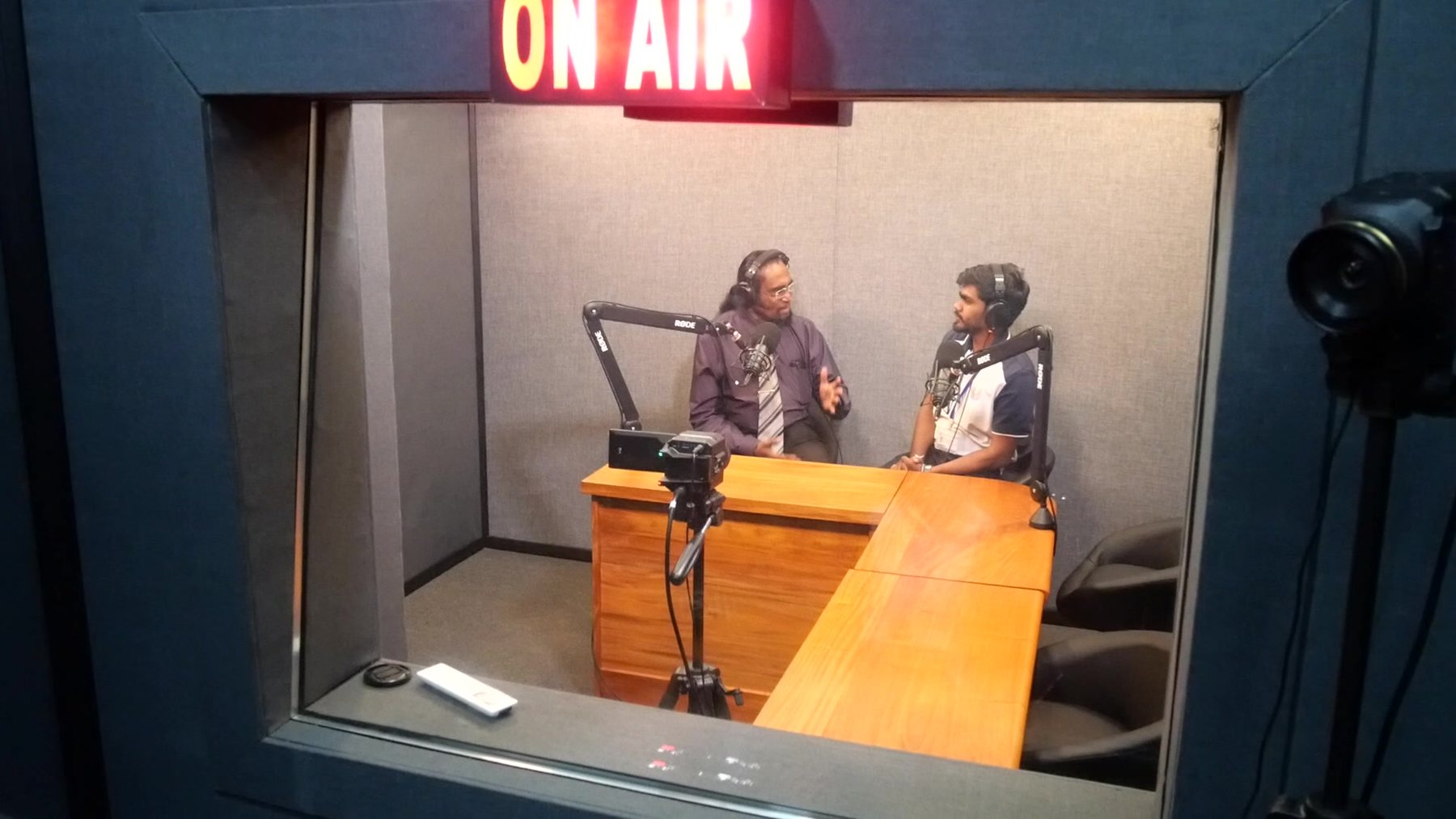
The University of Vocational Technology (UoVT) in Ratmalana now has a podcast and web radio training studio with its own control room, where students record podcasts, run live radio with phone-ins and stream multi-camera shows to YouTube, Facebook and the university LMS. It was opened by Prime Minister Dr. Harini Amarasuriya on 26 May 2026.
Project at a glance
Item | Detail |
|---|---|
Client | University of Vocational Technology (UoVT) |
Location | Ratmalana, Sri Lanka |
Year | 2026 |
Space | Presenter studio and separate control room |
Workflows | Podcast recording, internet radio with call-ins, multi-camera live streaming |
Scope | Turnkey: room construction, acoustics, equipment, furniture, lighting, power, air conditioning and network |
Integrator | Anscom Limited |
The client
The University of Vocational Technology is a state university in Ratmalana, set up under Act No. 31 of 2008. It teaches 3,381+ students across 17 programmes in four faculties: Education, Engineering Technology, Information Technology and Industrial Technology.
Media is a working discipline here, not a side subject. UoVT runs a Department of Film and Television Production and a B.Tech in Web and Creative Media, and its media complex already includes an HD production studio. Students graduate into newsrooms, production houses and radio stations, so they need time on real equipment.
The brief
UoVT wanted a multi-purpose broadcast training facility: one studio where students learn podcast production, internet radio and live video streaming on professional equipment. Four requirements shaped the design.
Three workflows in one room. Recorded podcasts, live radio with call-ins, and multi-camera streaming to YouTube, Facebook and the university LMS.
A real control room. Studio and control areas are separate, as in a professional station, so students learn signal flow and on-air discipline.
A quiet room. Recording and live broadcasts had to run without outside noise.
Industry-standard tools. Students train on the microphones, software and encoders they will meet at work.
The scope was turnkey: room construction, acoustics, equipment, furniture, lighting, power, air conditioning and network.
The solution
The studio is two purpose-built rooms, a presenter studio and a control room, with every part of the chain chosen for teaching.
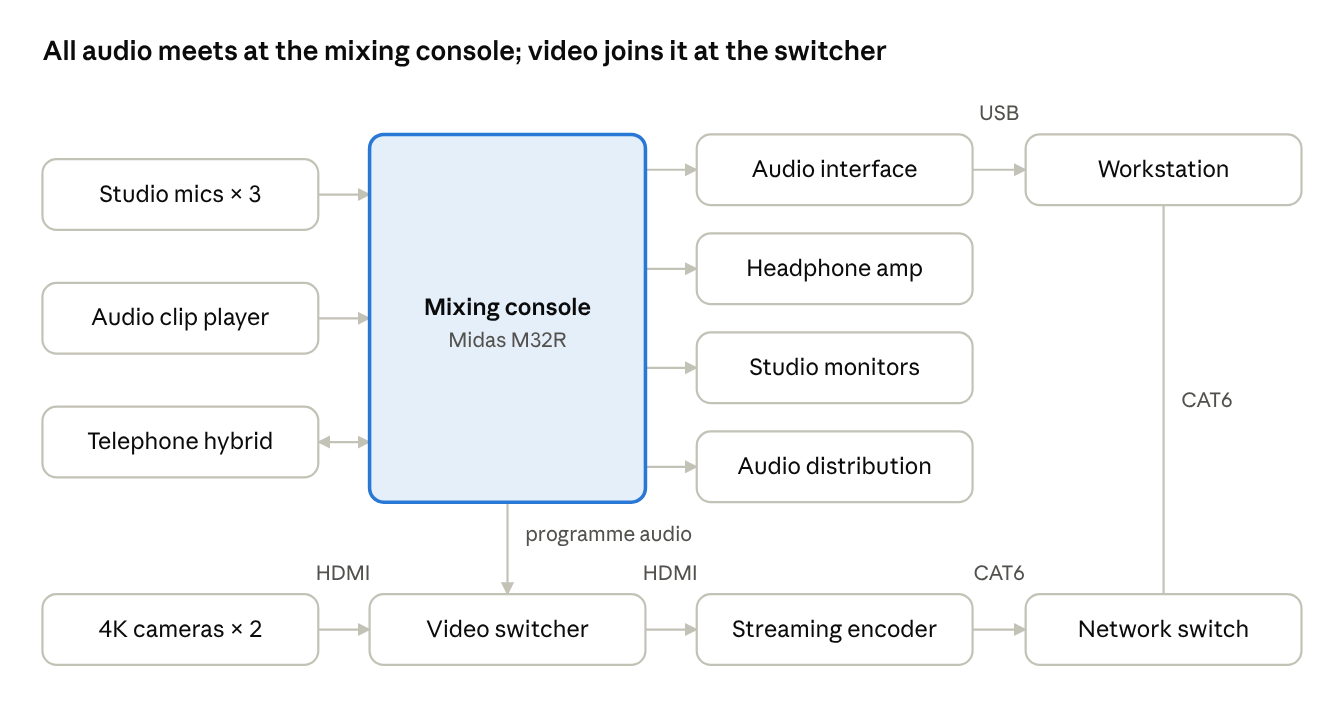
Microphones, the clip player and phone callers meet at the mixing console. From there the programme goes to headphones, monitors, the recording workstation and the live video chain.
The studio. A custom podcast table seats a host and guests at three RODE Procaster broadcast dynamic microphones, each on a PSA1+ boom arm with shock mount and windshield. Dynamic microphones reject room noise and forgive poor mic technique, which matters with student presenters. Everyone monitors on RODE NTH-100 closed-back headphones, and an Akai MPX8 pad player fires jingles, sound effects and programme cues.
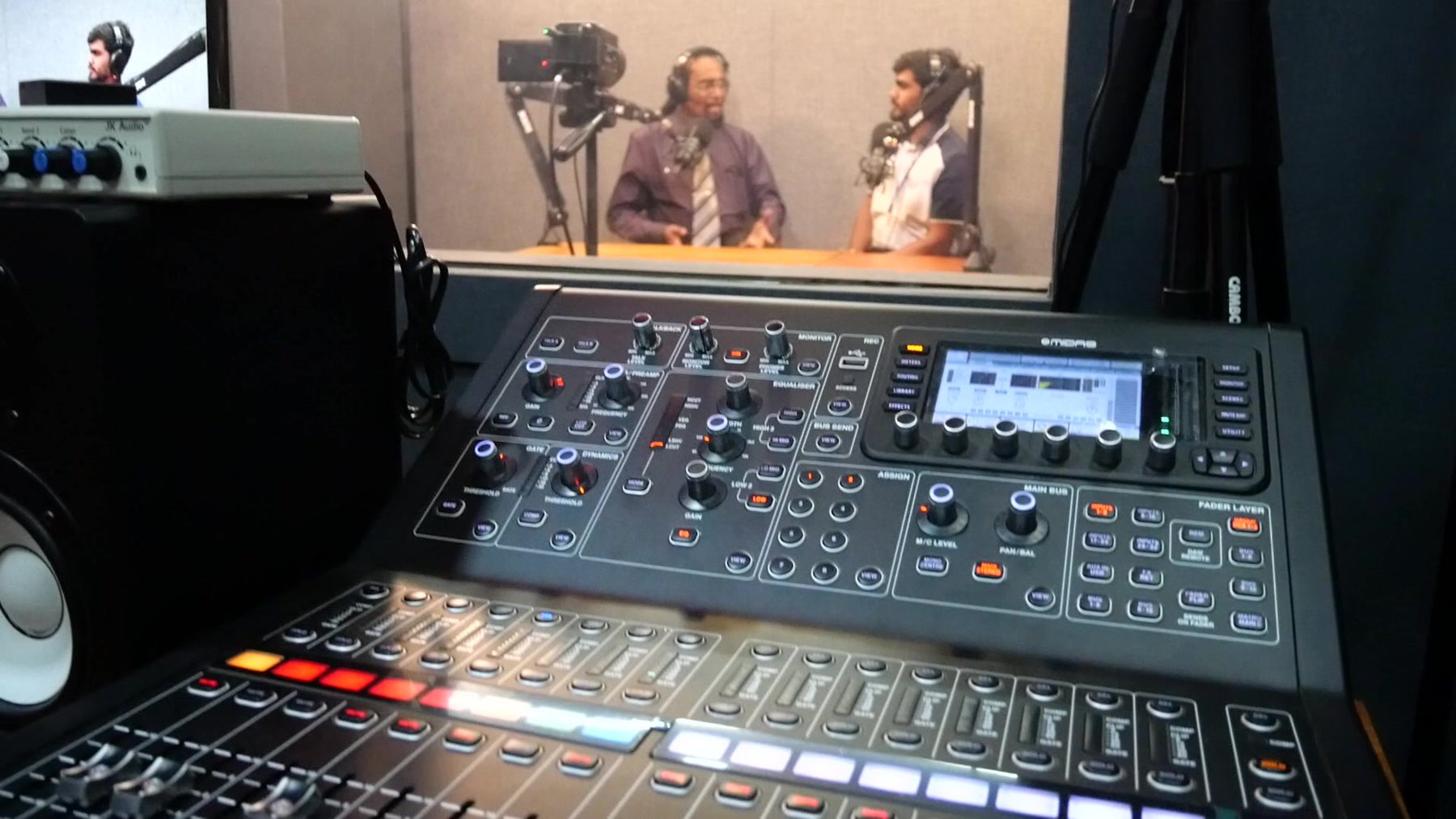
The control room. A Midas M32R digital mixing console sits at the centre of a custom console deck, with a Zoom UAC-232 32-bit float audio interface, an HP workstation with two monitors and a pair of Yamaha HS5 studio monitors. A Behringer HA8000 feeds the headphones and a Kramer VM-1110XL distribution amplifier routes programme audio to every destination. On-air lights tell both rooms when the microphones are live.
Internet radio. StationPlaylist Studio handles playout and scheduling, so the station stays on air between live shows. A JK Audio Broadcast Host telephone hybrid brings callers into the programme for phone-ins and live interviews. Steinberg Cubase Pro 14 covers editing and post-production.
Live video. Two Hollyland VenusLiv 4K streaming cameras feed a Blackmagic ATEM Mini Pro, the main video switcher, which also takes programme audio from the mixing console. vMix adds graphics and overlays for streaming, and a Kiloview E3 dual-channel HEVC encoder sends the programme to YouTube, Facebook and the LMS.
The rooms. Anscom built both rooms. The walls are two layers of 9 mm MDF around 50 mm of glass wool, finished with fabric-covered acoustic panels and an insulated door. Five bi-colour LED video lights, two inverter air conditioners, a 3 kVA online UPS and a managed network complete the facility.
Studio walkthrough
Equipment
Area | Equipment |
|---|---|
Mixing console | Midas M32R digital mixer |
Microphones | 3 × RODE Procaster with PSM1 shock mount, WS12 windshield and PSA1+ arm |
Headphones | 5 × RODE NTH-100, Behringer HA8000 headphone amplifier |
Clip player | Akai MPX8 |
Audio interface | Zoom UAC-232 |
Monitoring | Yamaha HS5 pair |
Telephone hybrid | JK Audio Broadcast Host |
Audio distribution | Kramer VM-1110XL |
Cameras | 2 × Hollyland VenusLiv 4K on K&F Concept tripods |
Video switcher | Blackmagic ATEM Mini Pro |
Streaming encoder | Kiloview E3 |
Software | StationPlaylist Studio, vMix HD (streaming graphics), Steinberg Cubase Pro 14 |
Workstation | HP Core i7 PC with 2 × MSI 24.5" monitors |
Lighting | NiceFoto SL-600A × 2 and SL-500A × 3 LED video lights, 3 × on-air signs |
Power and network | Navitas 3 kVA online UPS, TP-Link managed switch and access point |
My role
I designed and integrated this studio as Head of Systems Integration at Anscom Limited, the systems integrator that delivered the project. My work covered the functional design, equipment selection and bill of materials, system integration and commissioning. Anscom's team built the rooms, the acoustic treatment and the custom furniture.
Opening day
Prime Minister Dr. Harini Amarasuriya opened the studio on 26 May 2026 during her visit to the Ratmalana campus. UoVT's announcement lists the Podcasting Station alongside the new HD Production Studio, an AI Laboratory and the Centre for Gender Equity and Equality. The first podcast session was produced in the room that day.
What the studio enables
A campus web radio channel. News coverage of the opening describes a broadcasting studio with facilities for a web radio channel run for educational services.
Practical hours for media students. Presenting, panel operation, recording and editing are now taught on working equipment.
A shared university facility. UoVT lists the Podcasting & Web Radio Station among the facilities on its website.
FAQ
What is the difference between a podcast studio and a web radio studio? A podcast studio records programmes for later release. A web radio studio adds a live output: an encoder, a streaming server and playout software that keeps the station on air.
Can one room do both? Yes. The microphones, mixer and monitoring are shared. The web radio side adds the streaming chain and an on-air workflow.
What does a university need to start a web radio station? A treated room, broadcast microphones, a mixing console, a playout computer, a streaming service and trained student operators.
Do you design podcast and radio studios in Sri Lanka? Yes. I design and deliver podcast, recording and broadcast studios for universities, corporates and media houses. Contact me to discuss a project.
Sources
UoVT website: university facts, faculties, student numbers, facility listing
UoVT news, 26 May 2026: opening of the HD Production Studio and Podcasting Station
Newswire, 26 May 2026: web radio channel facility
UoVT invitation for bids, August 2025: acoustic treatment for the media studio
More on this kind of work: Broadcast Studio & OB Solutions in Sri Lanka →