Beyond the Box: Why You Need a Local AV Integrator Who Designs the Experience
By Kithnuwan Silva · Published
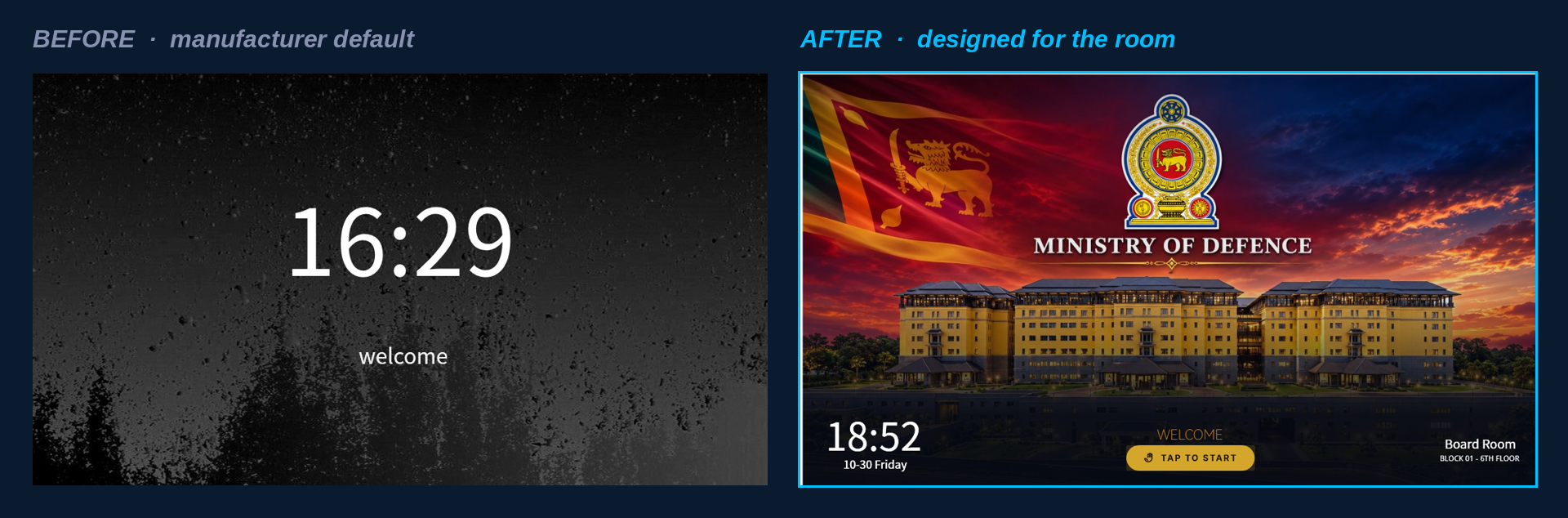
The equipment in two boardrooms can be identical and the meetings completely different. The difference is the experience: what people see when they walk in, how quickly the chairman's presentation reaches the screen, and whether anyone needs to call IT. That experience isn't in the box. A local integrator who understands the client has to design it.
This post shows what that means in practice, using the touch panel of a government boardroom we recently commissioned in Colombo. On the left of each comparison is the control interface as the manufacturer ships it; on the right is the interface we designed for the room.
What's wrong with the manufacturer's default control screens?
They are built to demonstrate the equipment, not to run your meeting. A manufacturer's template has to work for every customer in every country, so it describes the hardware rather than the room. In the default screens we replaced, that showed up in five ways:
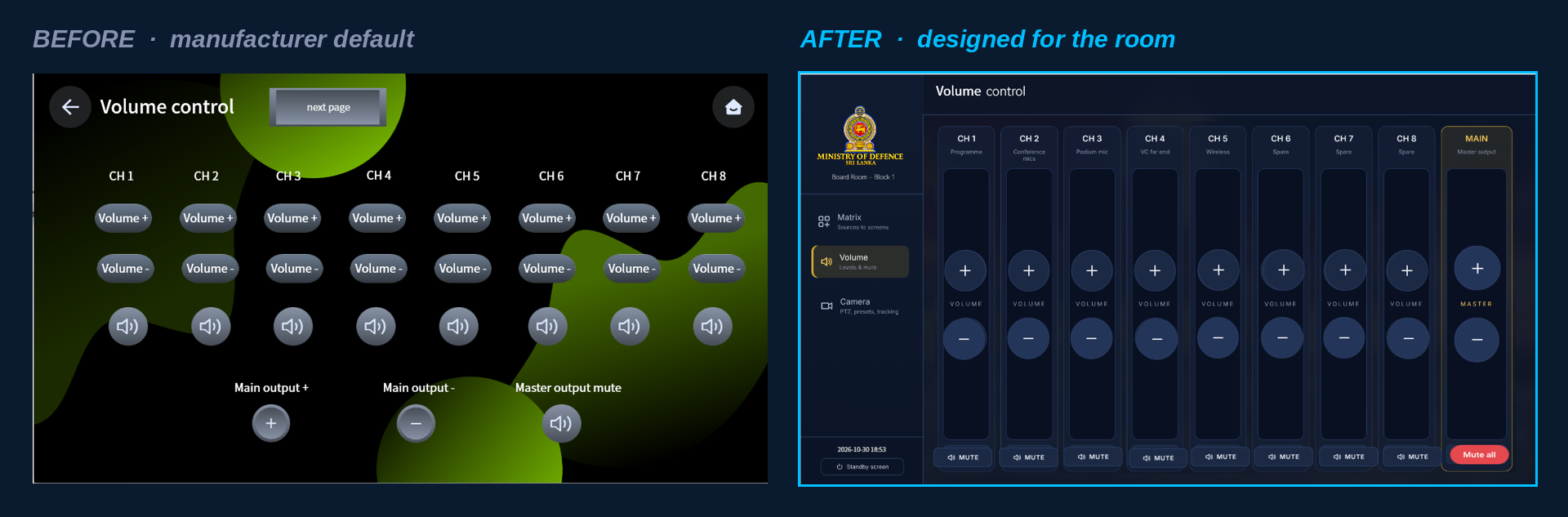
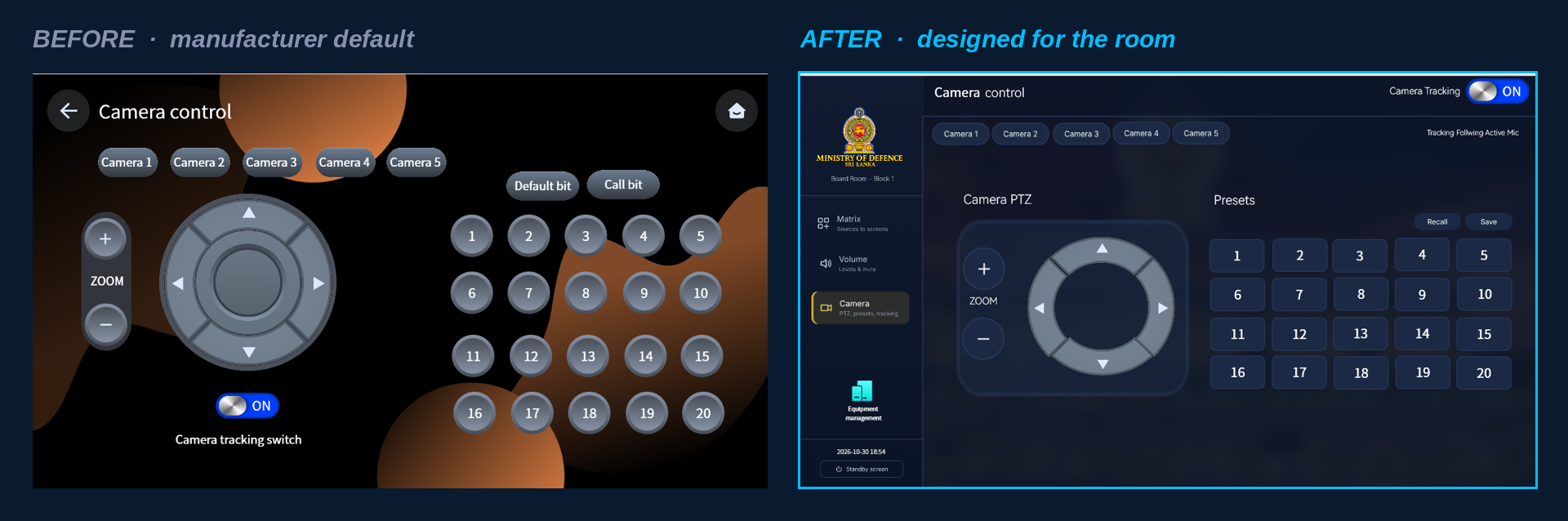
- Engineering words on the buttons. Camera presets were labelled "Default bit" and "Call bit". Volume channels were "CH 1" to "CH 8", with nothing to say which is the podium microphone and which is the far end of the video call.
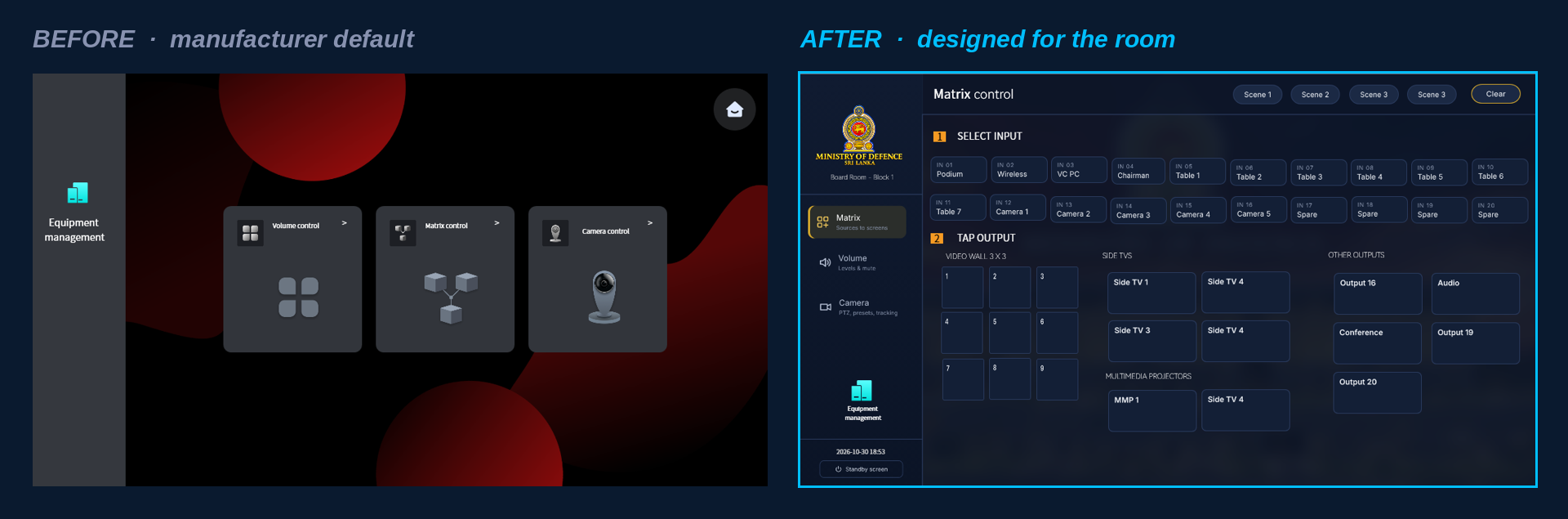
- One task split across several pages. Volume control needed a "next page" button, and getting from the home screen to the matrix meant passing through a generic "Equipment management" menu.
- Decoration instead of information. Brightly coloured shapes filled the background, while the room name, date and the organisation itself appeared nowhere.
- No sense of the room's layout. Nothing on screen matched the 3 × 3 video wall, the side displays or the projectors that the people at the table could actually see.
- No identity. A standby screen with a clock and the word "welcome" could belong to any room in any building.
Before and after: the same hardware, a different room
Every screen below controls the same matrix, DSP and cameras. Only the interface changed.
Routing: from a menu to a two-step matrix
Volume: from channel numbers to named sources
Cameras: from "Default bit" to Recall and Save
What changed, and why
Every change answers a question about how this particular room is used. None of it came from the template.
Design decision | Why it matters in this room |
|---|---|
Standby screen with the client's crest, building, room name and floor | The panel is the first thing a visiting delegation sees. It now looks like part of the institution, and staff can confirm they are in the right room. |
Inputs named by seat and source: Podium, Chairman, Table 1 to Table 7, Camera 1 to 5 | Operators think "put the Chairman's laptop on the wall", not "route input 4 to output 2". |
A numbered 1-2 routing flow: select input, then tap output | One page, two taps, and the numbers tell a new operator what to do first. |
Outputs drawn as they sit in the room: the 3 × 3 video wall, side TVs, projectors | Users pick a screen by where it is, not by remembering an output number. |
Saved scenes across the top of the matrix | Common layouts, such as presentation or video conference, are recalled in one touch instead of rebuilt each meeting. |
Volume channels named after what they carry, all on one page | During a live session the operator can lower the far end of the video call without guessing which channel it is. |
A separate master fader and a red Mute all button | The one control needed in an emergency is the easiest to find. |
Camera tracking that states "following active mic" | Users can see why the camera moves, and know which switch to use for manual control. |
The same left-hand navigation, clock and standby button on every page | Users always know where they are and how to get back, with no hidden menus. |
The hardware didn't change. What changed is that the room now works the way its users already think.
How do we build the experience?
We start with the people and the meetings, not the equipment list. The interface is designed before it is programmed, then tested and refined with the people who will use it every day.
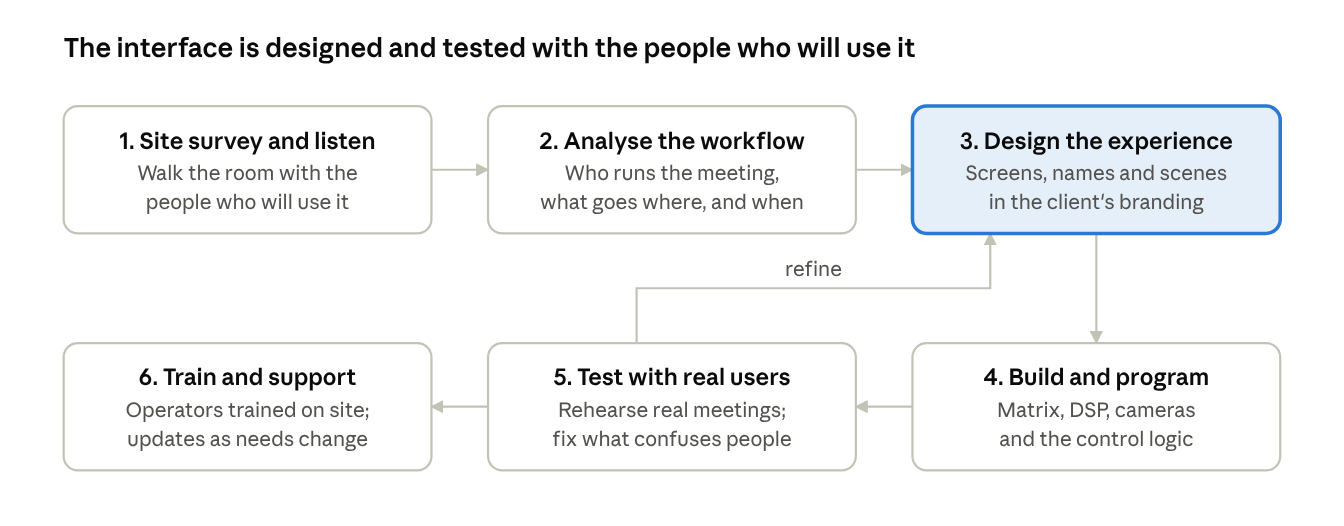
How we build a room's experience · 6 steps, 1 refinement loop
The loop between testing and design is where most of the value comes from. Watching a real operator run a rehearsal shows which labels confuse, which pages are never opened and which button is needed in a hurry.
Why does local experience matter in Sri Lanka?
Because the experience depends on knowing the people in the room, and a box shipped from overseas can't know them.
- We know how Sri Lankan boardrooms are run. Government, defence and corporate boardrooms here have a chairman, a secretary and an operator, each with a different job during a meeting. We design for each of those roles.
- We design for the client's identity. Crests, colours and naming conventions matter to institutions here. A room that carries them is treated as part of the organisation, not as borrowed equipment.
- We can be in the room. Requirements are gathered on site, the interface is tested with the people who will use it, and changes after handover take a visit, not a ticket to another time zone.
- We can adapt the interface over time. When a new screen, a renamed seat or a new meeting format arrives, the interface can be updated to match, because the people who designed it are a phone call away.
- We speak the users' language. Labels, training and support can be in English, Sinhala or Tamil, whichever the operators are most comfortable with.
We don't just deliver a solution; we build the experience
Any integrator can install a matrix, a DSP and five cameras. The value is in understanding how the room will be used, then shaping every screen, label and preset around that, so the technology disappears and the meeting runs.
If your boardroom, auditorium or control room works but doesn't feel like yours, the hardware is probably fine. It may only need its experience designed.
Kithnuwan Silva is a Senior AV & Broadcast Systems Consultant and Head of System Integrations at Anscom Limited, with 20+ years designing boardrooms, auditoriums and broadcast systems across Sri Lanka. Talk to me about your room.