What Is a Voice Lift System? How It Works and When a Room Needs One
By Kithnuwan Silva · Published

Short answer: a voice lift system uses ceiling microphones, a DSP and ceiling speakers to raise everyone's voice by a few decibels across a large room, so people can talk at a normal level and still be heard at the far end of the table. Done well, nobody notices it is on until it is switched off.
Have you ever sat in a large boardroom or lecture hall and strained to hear someone only a few metres away, in a room full of expensive cameras and displays? Video conferencing looks after the people on the screen. The people in the room are often left to shout.
This post explains how voice lift differs from a PA system, how it avoids feedback, what the DSP does, and where the microphones and speakers go.
Why can't people hear each other in a large meeting room?
Because the voice loses its high frequencies first as it travels. Those frequencies carry the consonants (s, f, t, p) that make speech understandable. When they fade, listeners catch the vowels but miss the words, meetings become tiring and people stop joining in.
What is the difference between voice lift and a PA system?
A PA system makes one presenter loud for a passive audience. Voice lift makes every participant slightly clearer for everyone else.
Traditional PA system | Voice lift | |
|---|---|---|
Purpose | One presenter to an audience | Everyone in the room to everyone else |
Level | Clearly louder than the talker | About 3 to 6 dB of lift, close to natural |
Microphones | Handheld, lectern or lapel | Ceiling or table microphones covering all seats |
How it feels | Amplified, sound comes from the speakers | Natural, people hardly notice it |
Best for | Lectures, announcements, events | Boardrooms, training rooms, lecture halls with discussion |
Voice lift also concentrates on the speech frequencies, restoring the lost consonants without adding low-frequency boom.
How does voice lift avoid feedback?
By zoning. Ceiling microphones pick up the room, and ceiling speakers play back into the same room, so a simple design would squeal. A voice lift system never sends a voice back into the zone it came from:
- A microphone in zone A (say, the front left of the table) feeds only the speakers in zones B and C.
- People near the talker hear them directly; people further away hear the lift.
- Because a microphone never hears its own amplified sound at close range, the feedback loop is broken.
The second rule surprises people who come from live sound: gain comes before uniform balance. Each ceiling microphone and each speaker is tuned on its own to the highest level it can reach without feedback. It is normal for microphone gains and speaker levels to end up different across the room.
What does the DSP do in a voice lift system?
The digital signal processor is the brain of the system. In a well-designed room it handles four jobs.
- Room equalisation. An oscillator plays a test signal into the room so the engineer can set a room EQ that flattens the room's own acoustic peaks and dips.
- Notch filters. Where a single frequency starts to ring, a narrow-Q cut removes just that frequency without dulling the voice.
- Two duckers. A key-in ducker lowers the ceiling microphones when a presenter turns on a handheld or wireless microphone, so the presenter has priority and the room stays stable. A self-ducker catches sudden loud speech right under a ceiling microphone before it can overload or ring.
- Smarter microphones. Modern ceiling arrays steer their pickup beams towards the talker and away from loudspeaker zones, and some DSPs add frequency-shifting feedback suppression for difficult rooms.
Conference mode and presentation mode
A touch panel lets the room switch between two set-ups:
- Conference mode for discussion: ceiling microphones (voice lift) and the presenter's microphone are both live.
- Presentation mode for a lecture or playback: voice lift is switched off so there are no open ceiling microphones, and only the presenter's microphone and the PC audio are amplified.
Where should the ceiling microphones and speakers go?
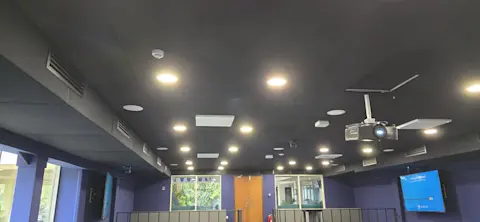
No DSP can rescue a bad layout. As an example, Yamaha's reference design for a conference room of about 120 m² seating around 20 people uses these distances:
Design parameter | Reference value |
|---|---|
Ceiling height | 3.0 m |
Listener ear height (seated) | 1.2 m |
Between ceiling microphones | 5.0 m |
Between ceiling speakers | 4.0 m |
Microphone to nearest speaker | at least 1.0 m |
Treat these as a starting point, not a rule. Every room is calculated from its own size, ceiling height, seating and acoustics, and the achievable gain is checked before the design is fixed.
PoE network speakers or passive speakers?
There are two common ways to build the speaker side:
- Dante PoE ceiling speakers. Each speaker takes network audio and power on one cable from the switch, which makes per-speaker routing and level adjustment simple.
- Passive ceiling speakers with a Dante amplifier. The DSP sends audio over the network to a multi-channel Dante power amplifier, which drives conventional low-impedance speakers. This suits projects that already specify passive speakers.
Voice lift in Sri Lanka: the IWMI multipurpose room
Sri Lanka's first voice-lifting system went into the International Water Management Institute's (IWMI) multipurpose room, a space used for board meetings, training and hybrid sessions. It is built on the Q-SYS ecosystem with Sennheiser TeamConnect Ceiling 2 microphones providing voice lift: six ceiling microphones, five tracking cameras that follow the active speaker, AV-over-IP video distribution and a touch control system.
Frequently asked questions
Will people notice the voice lift?
Usually not. The lift is only about 3 to 6 dB, which is why most people realise the system was helping only when it is switched off.
Does voice lift work with Microsoft Teams or Zoom?
Yes. The same ceiling microphones that provide the lift can also feed the video call, so remote participants hear the room while people in the room hear each other.
Does voice lift replace handheld microphones?
Not always. In a room that also hosts presentations, a handheld or wireless microphone is kept for the presenter, and the key-in ducker gives it priority over the ceiling microphones.
Which rooms need voice lift?
Large boardrooms, training rooms and lecture halls where people sit far apart and need to talk to each other, not just listen to one presenter.
Key takeaways
- Voice lift adds a natural 3 to 6 dB to speech, not a loud PA sound.
- Zoning stops each microphone from feeding its own nearby speakers, which breaks feedback loops.
- Gain comes before uniform balance: every microphone and speaker is tuned on its own.
- Room EQ, notch filters and two duckers keep the system stable.
- Layout matters as much as processing; reference distances are a starting point for each room's own design.
- A touch panel switches between conference mode and presentation mode.