Why Government AV Tenders Need Qualified AV Consultants
By Kithnuwan Silva · Published
A government AV project is usually won or lost before the first bid arrives, in the technical specification. Write it well and honest suppliers compete on price and quality. Write it badly and the best suppliers can't comply, bids can't be compared, and the institution may end up paying for equipment that doesn't do what was promised.
This post uses a recent donor-funded tender for a national monitoring centre's video wall as a worked example. Every issue below was raised formally with the procuring entity during the clarification stage. The point isn't to criticise one project. It's to show why AV specifications need to be written, or at least reviewed, by consultants who know AV equipment as well as they know procurement.
The example: a 5 × 3 video wall for a monitoring centre
The tender asked for a 5 × 3 wall of 55-inch LCD splicing panels driven by a UHD splicing processor, plus additional 65-, 75- and 98-inch displays, long video cable runs and a room audio system. On paper it looked thorough. In detail, several lines couldn't work as written.
What the specification said | The problem |
|---|---|
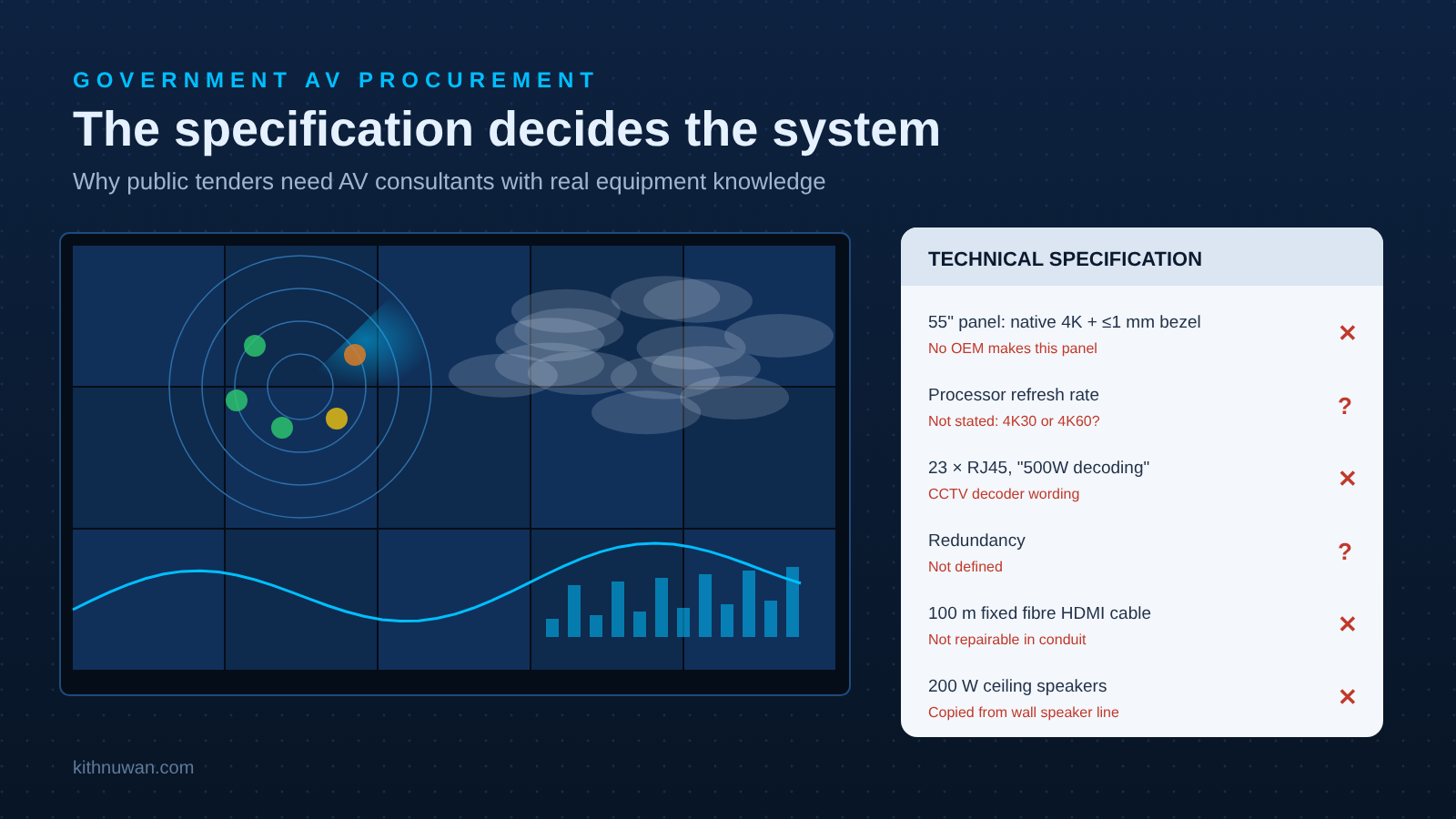
Each 55-inch panel: at least 4K UHD (3840 × 2160, 60 Hz) native resolution, with a joining seam of 1 mm or less | No major manufacturer makes this panel. Ultra-narrow-seam (about 0.88 mm) splicing panels are Full HD per tile; 4K is achieved across the wall, for example a 2 × 2 group of Full HD tiles. Clarifications then rejected both Full HD panels and 4K across several tiles. |
Processor output resolution and refresh rate | Not stated. 4K at 30 Hz and 4K at 60 Hz need different processors, HDMI generations, extenders and cabling, and very different budgets, so bids can't be compared. |
Processor: 23 × RJ45 10/100 ports and "500W / 300W / 200W / 130W / 100W decoding" | Language from CCTV network video decoders, not control-room video wall processors. It pushes bidders towards the wrong class of product. |
Redundancy | Not defined. Processor, power and signal-path redundancy each change the design and the price. |
100 m and 30 m fibre HDMI (AOC) cables for long links | A single fixed cable assembly in conduit can't be repaired; if damaged it must be re-pulled. Some PCs show HDCP and EDID problems on these cables. Extenders over replaceable cabling are the normal professional choice. |
Ceiling loudspeakers rated 200 W | Almost certainly copied from the wall-speaker line. Distributed ceiling speakers are typically tapped at a few watts to about 30 W on a 70 V or 100 V line. |
No clause requiring genuine, verifiable OEM products | Leaves the door open to re-badged or white-label panels whose declared specifications can't be checked against a manufacturer's website. |
Where a specification like this goes wrong
None of these lines looks dangerous on its own. Together, they create three problems that procurement committees rarely see until it's too late.
Genuine manufacturers are excluded. When the headline panel requirement can't be met by LG, Samsung, NEC, Panasonic or BOE, every honest bidder is technically non-compliant. The committee then has to choose between disqualifying everyone or accepting deviations, and either way the evaluation stops being fair.
Non-genuine products become attractive. A bidder willing to declare compliance on paper can offer a re-labelled or white-label panel with a datasheet that says "native 4K, 0.88 mm". Upscaled Full HD can be described as 4K. Without a requirement for manufacturer-verifiable specifications and international references for the same model, there is nothing to check the claim against, and the gap only appears after installation.
Bids can't be compared like for like. If refresh rate, redundancy and interfaces are undefined, one bidder prices a 4K60 redundant system and another prices a 4K30 single-processor system. The lowest price wins, but it isn't the same product. In a 24/7 monitoring room showing radar loops and satellite animation, that difference is the difference between smooth motion and visible judder, or between a wall that survives a processor fault and one that goes dark.
Smaller errors, such as 200 W ceiling speakers or CCTV decoder ports on a video wall processor, are signs that parts of the specification were assembled from vendor datasheets for other product types rather than designed for the room.
The consultant on paper vs the people doing the work
On many government and donor-funded projects, the client pays a well-known foreign consultancy precisely to avoid problems like these. The firm's name, international track record and senior experts are what win the consultancy contract.
The detailed work is often done by somebody else. To keep costs down, the firm hires local staff for the project, and those staff usually come from IT or general ICT backgrounds. They know networks, servers and software licensing. They usually haven't specified a video wall processor, designed a speaker layout, set up an echo canceller or commissioned a broadcast chain. Faced with an AV package, they do what anyone without AV experience would do: copy specifications from vendor datasheets and earlier tenders, and stitch them together.
That is how a CCTV decoder's port list ends up in a video wall specification, and how a resolution and a bezel width that no single panel offers get combined into one line. The government has paid international rates for consultancy, but the AV part of the job was effectively done by people with almost no AV knowledge.
This isn't a criticism of local engineers. Sri Lanka has capable AV professionals. The problem is that the consultancy contract rarely requires the people actually writing the AV specification to have AV experience. Procurement entities can fix that by asking:
- Who exactly will write the AV specification, by name, with a CV showing completed AV projects of similar size?
- What AV qualifications do they hold? For example, AVIXA CTS-D, or manufacturer design certifications such as Q-SYS, Crestron, Extron, Biamp or Dante.
- Will the firm's international AV specialist review and sign off the specification, or only appear in the bid document?
- Can the consultant name at least one manufacturer and model that meets each key line of the specification before it is published?
What a qualified AV consultant would specify instead
A consultant with real AV knowledge writes a specification that describes the outcome the room needs, in terms every genuine manufacturer can meet and every evaluator can verify.
Area | Specification written for the outcome |
|---|---|
Wall resolution | Full HD (1920 × 1080) per 55-inch tile, ≤ 0.9 mm combined bezel, with the processor able to map any 4K source across 2 × 2 or larger tile groups. |
Motion | Processor inputs, outputs and transport at 4K 60 Hz, 4:4:4 where required; HDMI 2.0 (18 Gbps) end to end. |
Architecture | Either a centralised processor with defined redundancy (dual power, hot-swap cards, standby controller), or distributed AV-over-IP on 10 GbE so no single box takes the whole wall down. Both should be allowed as compliant. |
Authenticity | Products must appear on the OEM's public website with matching model numbers and specifications, with a manufacturer's authorisation letter and at least five international references for the same model family. |
Long cable runs | 4K60 HDBaseT or fibre extenders over standard, replaceable cabling, with EDID and HDCP management. |
Audio | Ceiling speakers on a 70 V or 100 V line with selectable taps sized to the room, designed to a stated coverage and intelligibility target. |
Acceptance | Factory and site acceptance tests: pixel and uniformity checks, source-to-wall latency, failover demonstrations and serial number checks against OEM records. |
This isn't a more expensive specification. In most cases it's cheaper, because it opens the tender to mainstream products and removes the risk premium bidders add when requirements are unclear.
Why this matters for public money
Government and donor-funded AV systems are expected to run for eight to ten years. A specification error costs money several times over:
- Re-tendering. If clarifications can't resolve a contradiction, the tender may need to be cancelled and re-issued, adding months to the project.
- Equipment that underperforms. A wall that can't play radar loops smoothly, or audio that can't be understood, still has to be paid for.
- Hidden lifetime costs. Unrepairable cables, proprietary or unsupported panels and single points of failure all turn into emergency spending later.
- Audit exposure. When the delivered system can't be matched to the specification, both the procurement committee and the supplier face difficult questions.
In every one of these cases, a few days of qualified specification review at the start would have cost far less than the problem it prevents.
Recommendations for procurement committees
- Engage a consultant with hands-on AV experience, not only general ICT or procurement experience. Ask for past AV projects of similar scale and references from end users.
- Validate every key specification with at least two genuine manufacturers before the tender is issued. If no OEM can name a compliant model, the specification is wrong.
- Write performance-based requirements (resolution at wall level, refresh rate, latency, uptime) rather than copying a single vendor's datasheet.
- Define redundancy and acceptance testing in the tender, so every bidder prices the same system and the delivered system can be checked against it.
- Require OEM authenticity evidence: public product pages, authorisation letters and international references for the same model family.
- Treat clarification questions as a quality check. When several experienced bidders raise the same issue, it's usually a sign the specification needs to change, not that the bidders want an easier tender.
Closing thought
A video wall, a parliament broadcast system or a boardroom is only as good as the specification it was bought against. Good AV consultants don't just make tenders harder to win. They make sure the institution gets the system it actually needs, from suppliers who can actually deliver it.