Why Your Hybrid Room Needs Good AEC: The Missing Piece in Sri Lankan Meeting Rooms
By Kithnuwan Silva · Published
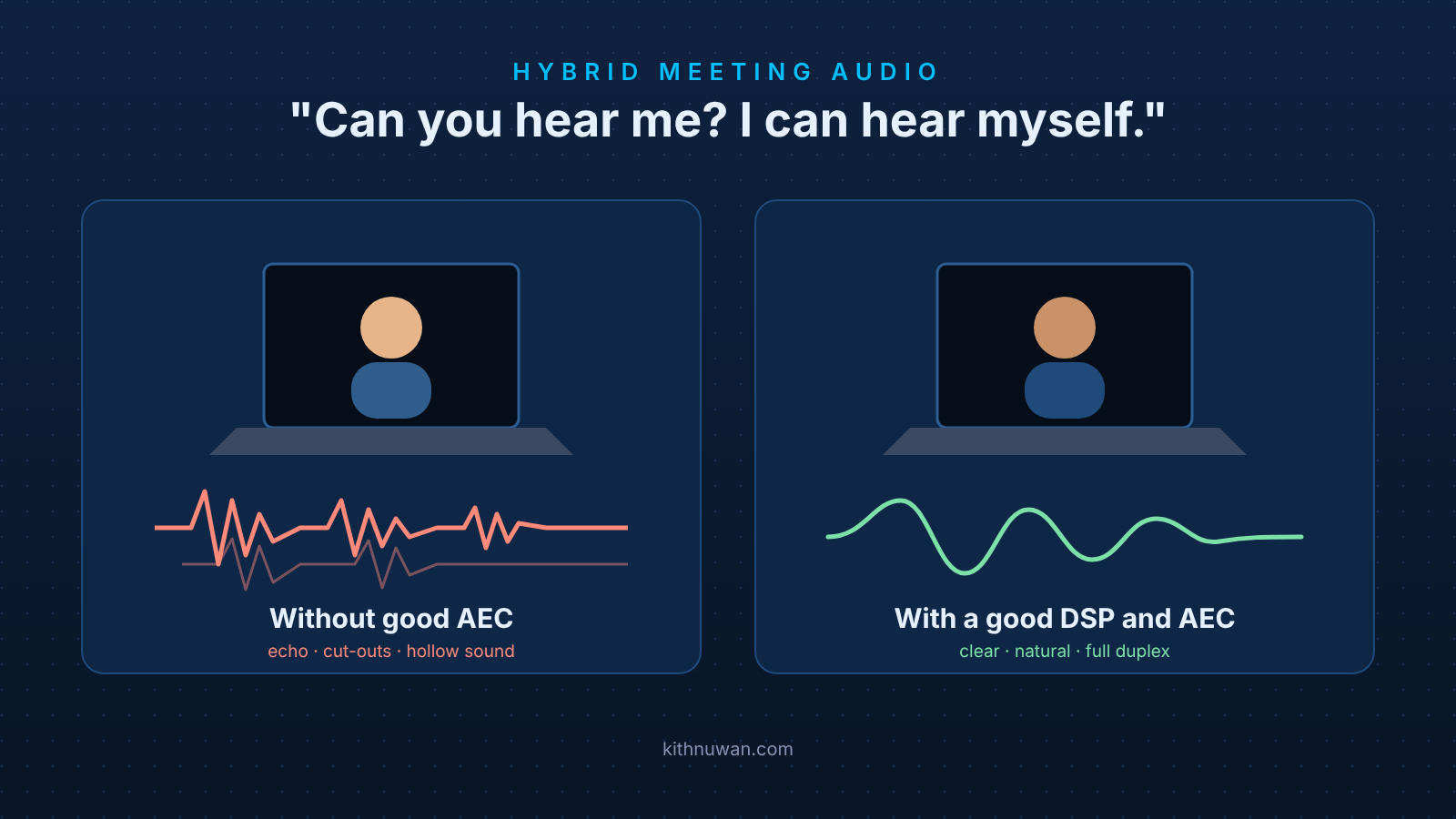
In a hybrid meeting, the people in the room almost never hear the problem. The remote participants do. They hear their own voice come back a moment later, voices cut in and out when two people talk at once, or a hollow, distant sound from across the table. Most of the time the cause is the same: weak or missing acoustic echo cancellation (AEC).
In many Sri Lankan meeting rooms, the budget goes on the display and the camera, and audio is a couple of microphones plugged into a mixer or a laptop. This post explains what AEC does, why a proper DSP with good AEC makes remote audio sound natural, and what to specify so your next room gets it right.
What is AEC and how does it work?
Acoustic echo cancellation stops the far end's own voice from being sent back to them. When a remote participant speaks, their voice plays from the room's loudspeakers, bounces around the room and reaches the room microphones. Without AEC, that echo goes straight back to them.
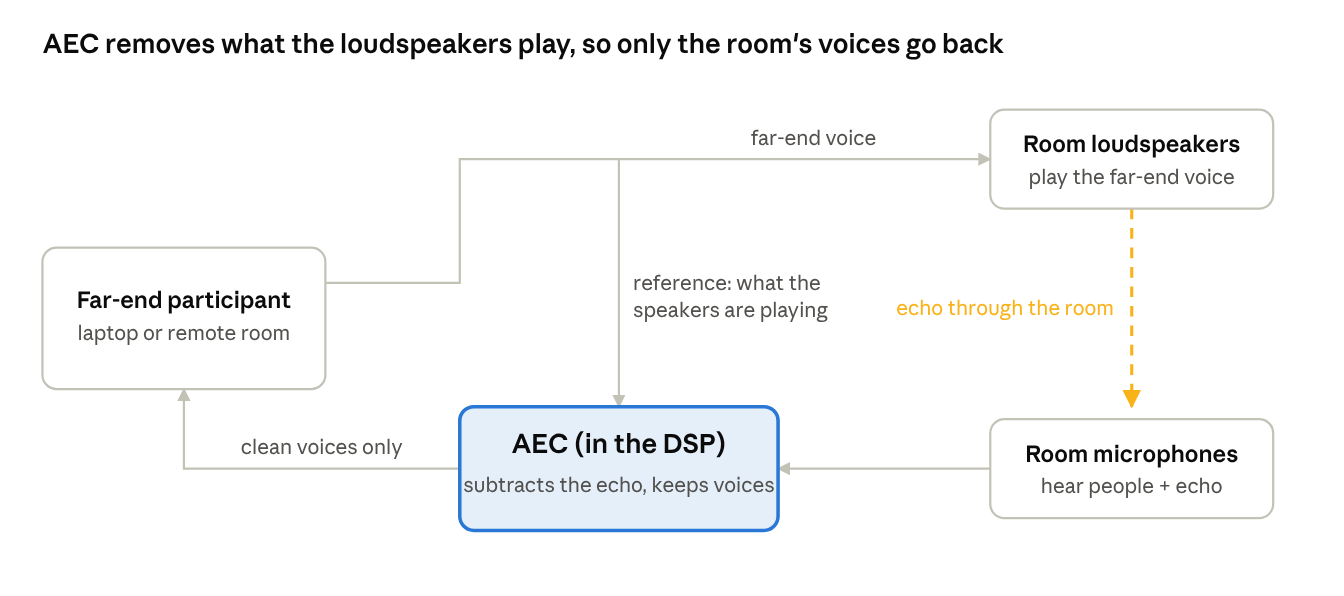
The AEC is given a copy of exactly what the loudspeakers are playing, called the reference. It learns how the room changes that sound on its way to each microphone, then subtracts its prediction of the echo from the microphone signal. What's left, and sent to the far end, is just the voices of the people in the room. Because the room changes as people move, open laptops or close the door, the AEC keeps learning throughout the call.
What does bad AEC sound like to the remote side?
If remote participants regularly say any of these, the room's echo cancellation isn't doing its job.
What remote people say | What's actually happening |
|---|---|
"I can hear myself." | Their voice plays from the room speakers, is picked up by the room microphones and sent back to them. |
"You keep cutting out when I talk." | The system uses echo suppression: it turns the room microphones down whenever the far end speaks, so nobody can interrupt or ask a quick question. |
"It sounds like you're in a bathroom." | A reverberant room is longer than the echo canceller can model, so the tail of the echo gets through. |
"There's a strange, metallic sound." | Loudspeakers are distorting, or an echo canceller is working on a signal it can't model, and the leftover echo comes through distorted. |
"It's silent, then suddenly loud." | Noise gates, or no comfort noise, make the line drop to dead silence between words. |
The people in the room hear none of this, which is why it can go unnoticed for months while remote colleagues and clients quietly stop joining from that room.
What does a good DSP add on top of AEC?
A proper conferencing DSP (such as Q-SYS, Biamp or a well-built all-in-one system) runs a chain of processing on every microphone. AEC is the heart of it, but the rest is what makes remote audio sound natural rather than just echo-free.
- Full-duplex conversation. Good AEC cancels the echo instead of muting the microphones, so both sides can talk at the same time, interrupt and laugh, the way a real conversation works.
- Non-linear processing. Removes the small amount of echo the adaptive filter leaves behind, especially in the first seconds of a call while the AEC is still learning the room.
- Noise reduction. Takes out steady noise such as air-conditioning and projector fans without making voices sound underwater. A modest setting, around 10 dB, keeps speech natural.
- Comfort noise. Fills the gaps with a little background sound so the line never drops to dead silence, which listeners find unsettling.
- Automatic gain control. Keeps the quiet speaker at the far end of the table and the loud one near the microphone at a similar level.
- Automatic mic mixing. Opens the microphone nearest the person speaking and turns the others down, so the far end hears one clear voice instead of the whole room's reverberation.
- A long enough echo tail. Q-SYS, for example, typically uses a 200 ms tail and allows 400 ms for very reverberant rooms, so the AEC can model the whole echo of the room.
The most common mistakes we see in Sri Lankan rooms
- No AEC at all. Wired or wireless PA microphones go into a mixer, the mixer goes into a laptop, and the laptop's speakers or the room PA play the far end. The laptop's built-in echo cancellation was never designed for a room full of microphones and loudspeakers.
- Two echo cancellers fighting each other. A room DSP with AEC feeds a Teams or Zoom PC that also applies its own echo cancellation, or a USB speakerphone sits on the table next to a ceiling microphone system. There should be one echo canceller per microphone, in one place.
- AEC after the mixer. Mixing several microphones first and then running one AEC channel saves money, but the mixer's constant gain changes keep changing the echo path, and the AEC never settles. Each microphone needs its own AEC channel, before the mixer.
- The wrong reference signal. The AEC must be told exactly what the loudspeakers are playing: the far-end voice and any programme audio. A microphone must never be sent to its own reference.
- Distorting loudspeakers. Cheap or overdriven loudspeakers add distortion the echo canceller can't model, so some echo always gets through. Good loudspeakers at sensible levels make the AEC's job easier.
- An untreated room. Glass walls and hard ceilings create long reverberation. The longer the room rings, the harder the AEC has to work, and some reverberation always reaches the far end. Acoustic treatment and good AEC work together.
What to specify for a hybrid room
- A conferencing DSP or certified all-in-one system with AEC on every microphone channel
- One echo canceller per microphone, before the automatic mixer
- AEC disabled on the meeting PC or codec when the room DSP does it (or the other way round), never both
- The AEC reference fed with exactly what the loudspeakers play
- Echo tail long enough for the room (200 ms typical, 400 ms for reverberant rooms)
- Noise reduction, comfort noise and automatic gain control set during commissioning
- Good-quality loudspeakers run well below distortion
- Acoustic treatment so the room isn't fighting the AEC
- A test call from a remote laptop at handover, with double-talk, to hear the room as the far end does
During commissioning, the DSP's echo return loss enhancement (ERLE) meter tells you how well the AEC is working. On Q-SYS, readings above 20 dB while only the far end is talking show it's doing its job.
Remote participants are half the meeting
A hybrid meeting only works if the people joining online feel as present as the people in the room. Good AEC is invisible when it works: nobody notices it, and the conversation simply flows. That's exactly the point.
Kithnuwan Silva is a Senior AV & Broadcast Systems Consultant and Head of System Integrations at Anscom Limited, with 20+ years designing meeting rooms, boardrooms and broadcast systems across Sri Lanka. Talk to me about your hybrid room.
Sources
- Acoustic Echo Canceler component, Q-SYS Help: how AEC works, tail length and ERLE
- Q-SYS Acoustic Echo Cancellation white paper, QSC: NLP, noise reduction, comfort noise and AGC
- AEC reference principles, Bose Professional: one AEC per microphone before the mixer, reference signals, distortion
- Per-channel AEC referencing, Biamp: never send a microphone to its own reference
- Acoustic echo canceller white paper, Yamaha: echo suppression versus cancellation and double talk