HDBaseT vs AV over IP: What's Best for Sri Lanka?
By Kithnuwan Silva · Published
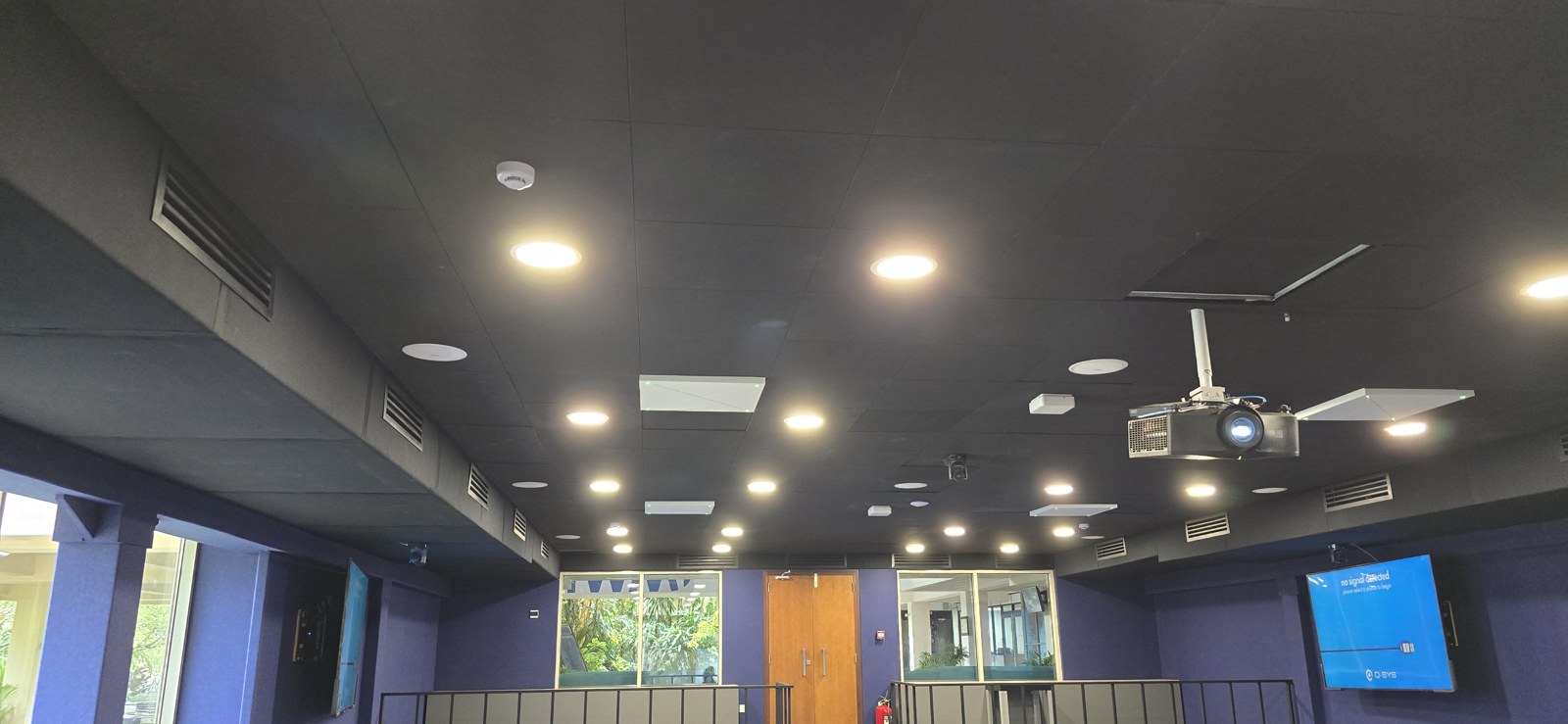
Short answer: for most Sri Lankan projects in 2026 (single boardrooms, classrooms, training rooms), HDBaseT is still the lower-risk, lower-cost choice. AV over IP wins once you have many sources and displays, multiple rooms or floors, or distances beyond 100 m. The smartest designs today use both.
Almost every client meeting I attend now has the same question: "Shouldn't we go AV over IP? Isn't HDBaseT old?" It is a fair question. AV over IP is where the global industry is heading, and 2026 is the year the open IPMX standard became certifiable. But what is right for a bank boardroom in Colombo or a university lecture hall in Sabaragamuwa is not always what is right for a corporate campus in Singapore.
After about 20 years of designing and commissioning AV systems in Sri Lanka, here is how I actually decide.
What HDBaseT is
HDBaseT is a point-to-point extension technology. A transmitter at the source sends video, audio, control, USB and Ethernet over one Cat cable to a receiver at the display, typically up to 100 m. There is no network switch in between; the cable is the link.
The current version, HDBaseT Spec 3.0, carries uncompressed 4K60 4:4:4 HDMI 2.0, 1 Gb Ethernet, USB 2.0, control and power with near-zero latency. It is backward compatible with older HDBaseT gear and is best run on Cat 6A shielded cable. Most HDBaseT installed in Sri Lanka today is still the older 2.0 class (4K60 at 4:2:0), which is fine for most meeting rooms.
Where it shines:
- A laptop at the table to a projector or display at the far end of the room
- A 4x4 or 8x8 HDBaseT matrix feeding a handful of displays in one space
- Extending a USB camera and speakerphone to a room PC for Teams or Zoom
- Any room where the client's IT team does not want AV traffic on their network
What AV over IP is
AV over IP turns every source and display into a network endpoint. An encoder converts HDMI into an IP stream, a managed Ethernet switch carries it, and any decoder on that network can pick it up. Switching becomes software, so adding a room means adding endpoints rather than replacing a matrix.
There are three families you will meet in Sri Lankan tenders and quotes:
- 1 Gb systems with compression (H.264/H.265, JPEG XS and similar). Cheaper endpoints and ordinary Cat 6 to the switch, at the cost of some latency and image processing.
- 10 Gb systems (for example SDVoE). Visually lossless 4K with very low latency, but they need 10 Gb switch ports and often fibre uplinks.
- Audio and ecosystem protocols such as Dante and NDI, which many projects already use for audio or production even when video is on HDBaseT.
The big 2026 change is interoperability. At ISE 2026 the Alliance for IP Media Solutions launched IPMX as a fully developed, certifiable AV-over-IP standard, with certified products on the show floor. IPMX supports 4K60 over a single gigabit network and HDCP for protected content (AIMS). For buyers this matters: mixing brands on one network is becoming realistic, instead of being locked into one manufacturer's proprietary system.
Head to head
Factor | HDBaseT | AV over IP |
|---|---|---|
Topology | Point to point, or via an HDBaseT matrix | Any source to any display over a network |
Distance | Up to 100 m per link | Unlimited via switches and fibre |
Video quality | Uncompressed (Spec 3.0: 4K60 4:4:4) | Compressed on 1 Gb; near-lossless on 10 Gb |
Latency | Near zero | Low to very low, depends on codec |
Scaling | Fixed by matrix size; growth means a bigger matrix | Add an encoder or decoder and a switch port |
Network dependency | None | Managed switch with multicast (IGMP) set up correctly |
Skills needed | Good cabling and termination | Cabling plus network design and AV-IT coordination |
Cost for 1 room | Lower | Higher (endpoints plus switch) |
Cost for 20+ endpoints | Rises steeply with matrix size | Often lower per endpoint |
Failure impact | One link fails, one display is affected | A switch or config fault can affect the whole system |
Interoperability | Good between HDBaseT-certified brands | Improving fast with IPMX; many systems still proprietary |
Why Sri Lanka changes the answer
The spec sheets are the same everywhere. Our conditions are not. These are the factors I weigh on every local project.
1. Most of our rooms are single rooms. The bulk of Sri Lankan AV work is boardrooms, meeting rooms, classrooms and training rooms, mostly under 100 m from source to display. That is exactly HDBaseT's sweet spot. Putting a network in the middle of a single room adds cost and points of failure without adding much.
2. Every rupee is imported. Almost all AV hardware is priced in dollars, then duties and taxes apply. AV over IP needs an encoder per source, a decoder per display and a properly specified managed switch. For a small room that bill of materials is noticeably higher, and the difference is hard to justify to a finance committee.
3. The network is the real risk. AV over IP only works when multicast, IGMP snooping and querier, VLANs and QoS are set up correctly. Many organisations here have small IT teams who, rightly, do not want video streams on the corporate LAN. If AV runs on its own dedicated switch, someone still has to own and maintain it after handover.
4. Power and lightning. Voltage fluctuations and monsoon lightning are a fact of life. A central switch without a good UPS and surge protection becomes a single point of failure for the whole building. With HDBaseT, a damaged extender takes out one display, not every room.
5. Support and spares. Ask who stocks spare encoders, decoders or switch modules locally, and how long a replacement takes to arrive. A proprietary AV-over-IP system with no local stock can leave a room dark for weeks. HDBaseT extenders from several brands are easier to source and swap.
6. Cable quality on site. HDBaseT at full distance is sensitive to cable grade and termination quality. Poor Cat 6 runs and bad crimps are still common on our sites. Specify Cat 6A shielded for HDBaseT, test every run, and do not push links to the full 100 m.
7. Tenders are starting to ask for IP. Government and university tenders increasingly specify "IP-based" distribution. Where that is the requirement, choose standards-based systems (IPMX, Dante) rather than single-brand ecosystems. It keeps future bids open to more than one supplier.
Which one for your project?
Your project | My recommendation |
|---|---|
Single boardroom or meeting room | HDBaseT |
Classroom or lecture hall, standalone | HDBaseT |
Divisible room (2 to 3 sections) | HDBaseT matrix, or small AV over IP if growth is planned |
5+ rooms that must share content | AV over IP |
Multi-floor office, hotel or campus | AV over IP on a dedicated AV network |
Video wall or control room | AV over IP (10 Gb where latency matters) |
Digital signage across a building | AV over IP (1 Gb compressed is fine) |
Broadcast, live production, streaming studio | IP workflows (NDI, ST 2110, IPMX) |
Runs over 100 m | AV over IP, or HDBaseT with fibre extension |
The hybrid approach. In practice many of our best systems combine both. HDBaseT handles the in-room links: wall plates, table boxes, the projector run. AV over IP and Dante link the rooms together and to central sources. Some newer products, such as PlexusAV's HDBaseT 3.0 to IPMX transceiver, are built for exactly this. You get the simplicity of HDBaseT where people plug in, and the flexibility of IP across the building.
My verdict for Sri Lanka
Do not choose AV over IP because it sounds modern, and do not avoid it because it sounds complicated. Choose by the number of endpoints, the distances, and who will look after the network in five years.
For a single room, HDBaseT is still the honest recommendation: lower cost, less to go wrong, and easier to support locally. For multi-room, multi-floor or campus projects, AV over IP is the right investment. With IPMX now certifiable, specify open standards so you are not tied to one brand. Whichever you choose, budget for good Cat 6A cabling, a proper UPS, and a design done before the equipment is ordered.
If you are planning a boardroom, classroom or building-wide AV system and want a second opinion on the architecture, get in touch.
FAQ
Is HDBaseT obsolete in 2026? No. HDBaseT Spec 3.0 carries uncompressed 4K60 4:4:4 over 100 m and remains the simplest choice for single rooms. AV over IP is growing, but it replaces HDBaseT mainly in large multi-room systems.
Is AV over IP more expensive than HDBaseT? For one room, usually yes, because you pay for encoders, decoders and a managed switch. Beyond roughly 15 to 20 endpoints, AV over IP is often cheaper and far easier to expand than a large matrix.
Can AV over IP run on our existing office network? It can, but it is rarely a good idea. Video streams need multicast configured correctly and can affect other traffic. A dedicated AV network, or a separate VLAN with QoS agreed with your IT team, is safer.
What is IPMX? IPMX is an open AV-over-IP standard from the Alliance for IP Media Solutions, launched as fully certifiable at ISE 2026. It lets products from different manufacturers work on the same network.
What cable should I use for HDBaseT? Cat 6A shielded (U/FTP or S/FTP), properly terminated and tested. Keep runs comfortably below 100 m.