IP-Based PA vs Traditional Analogue PA: Which Is Right for Your Facility?
By Kithnuwan Silva · Published
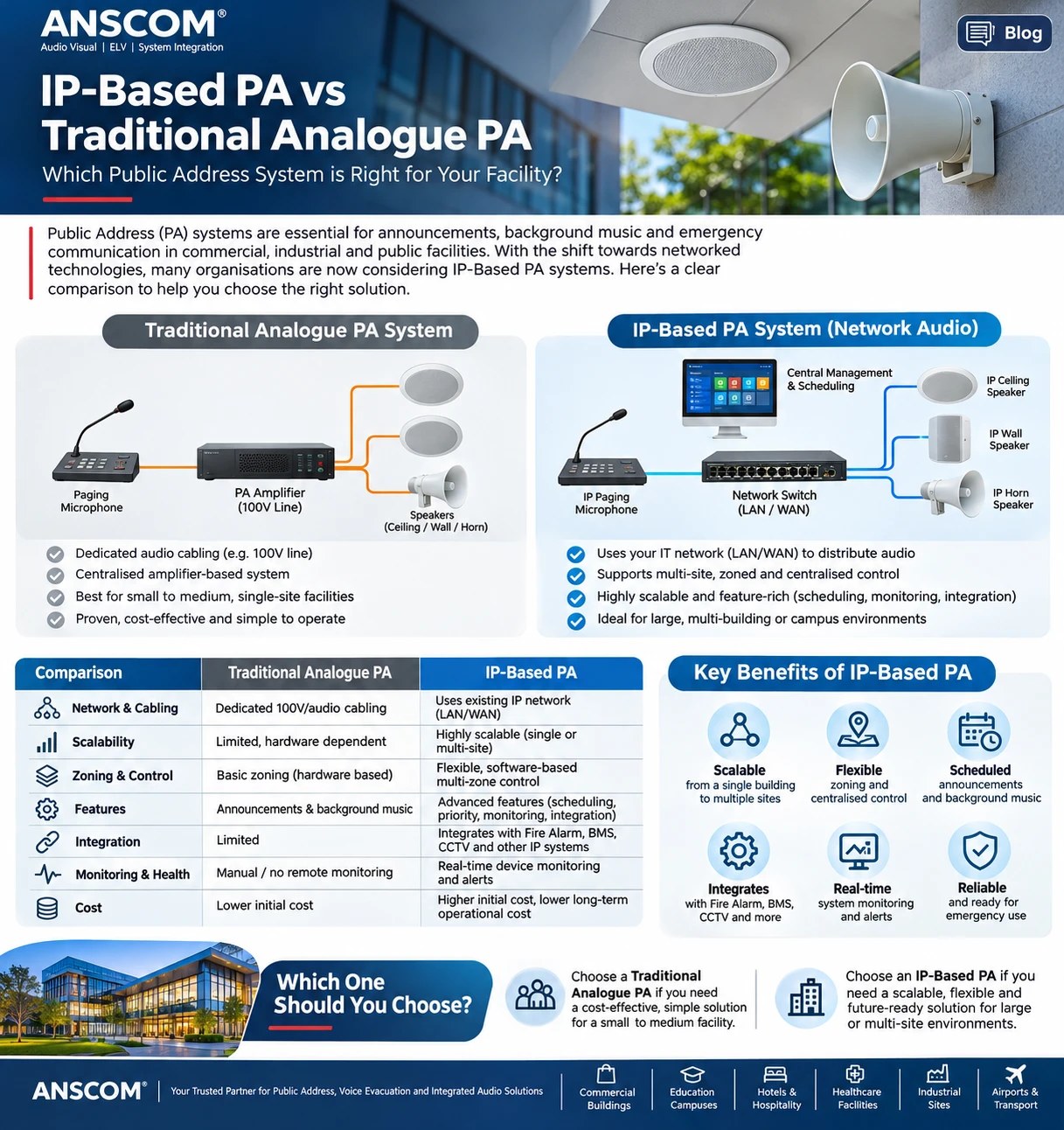
One of the first questions I get on a public address project is whether to go with an IP-based system or stay with a traditional analogue one. The honest answer is that neither is better in general. Each suits a different kind of building, and many of the best designs use both.
If you are new to the topic, start with What Is a Public Address System?. This post assumes you know the basics and want to choose between the two approaches.
The short answer
- Single building, a handful of zones, simple paging and background music: a traditional 100V analogue system is cheaper, simpler and very reliable.
- Multiple buildings or branches, many zones, central control and monitoring: an IP-based system earns its cost.
- Most medium to large buildings: a hybrid, with IP between floors or buildings and 100V speakers within them, gives the best balance.
How a traditional analogue PA system works
A traditional system is centralised. Paging microphones and music sources feed a mixer or matrix, which feeds power amplifiers in an equipment rack. From there, dedicated speaker cables run out to each zone, almost always on 100V line so that many speakers can share one long cable.
Where it is strong
- Proven technology with decades of field history
- Lowest cost per speaker
- No dependence on the IT network
- Easy for a facilities team to operate and maintain
- Speakers need no power or data, only a two-core cable
Where it struggles
- Every zone needs its own cable run back to the rack, and often its own amplifier channel
- Changing zones later means changing wiring
- Linking separate buildings needs extra cabling or additional equipment
- Remote monitoring and fault reporting are limited unless you add dedicated hardware
How an IP-based PA system works
An IP-based system sends audio and control as data over an Ethernet network. Paging stations, speakers, amplifiers and the management software are all network devices, each with its own address.
There are two common architectures:
- IP end points. Each speaker has its own built-in amplifier and network port, usually powered over PoE. Every speaker can be addressed individually.
- Network amplifiers. A network-connected amplifier sits on each floor or in each building and drives ordinary 100V speakers locally.
Where it is strong
- Zones are defined in software, so they can be changed without rewiring
- One system can cover several buildings or sites over the LAN or WAN
- Central scheduling for bells, prayers, music and recorded messages
- Device status and faults can be seen from one screen
- Integrates with other IP systems, such as telephony (SIP) and building management, through supported interfaces
Where it struggles
- Higher cost per speaker for IP end points
- It is only as reliable as the network and the power behind it
- Needs coordination with the IT team from day one
- Adds cybersecurity considerations that an analogue system does not have
Side-by-side comparison
Feature | Traditional analogue PA | IP-based PA |
|---|---|---|
Audio distribution | Dedicated speaker cable, typically 100V line | Ethernet / IP network |
Architecture | Centralised amplifiers | Centralised or distributed |
Zoning | Fixed by wiring and hardware | Configured in software |
Scalability | Limited by amplifier and cabling capacity | Limited by network capacity and PoE budget |
Multi-site operation | Complex | Supported over LAN or WAN |
Remote monitoring | Optional, needs extra hardware | Commonly built in |
Integration | Dedicated interfaces and contacts | Network protocols, APIs and gateways |
Cable distance | Hundreds of metres per speaker line | 90 m per copper network run, fibre beyond that |
Power to speakers | From the amplifier, over the speaker cable | PoE switch or local supply |
Dependence on IT network | None | Complete |
Initial cost | Usually lower | Depends on devices and network readiness |
Skills to maintain | Audio / electrical | Audio and networking |
What an IP PA system asks of your network
This is the part most comparisons leave out, and it is where IP projects succeed or fail.
- PoE budget. A PoE (802.3af) port delivers about 15W and PoE+ (802.3at) about 30W at the switch. That limits how loud an IP speaker can be, and the switch's total power budget limits how many you can connect. Horn speakers for outdoor or factory use usually need PoE+ or a local supply.
- A separate VLAN and QoS. PA audio should be isolated from general office traffic and prioritised, so that an announcement is not delayed by a large file transfer.
- Multicast handling. Many IP PA systems use multicast to reach groups of speakers. Switches need IGMP snooping configured properly, or the audio will flood the network.
- Backup power. If the switches go down in a power cut, so does the PA. Network switches serving the PA need UPS support.
- Cable length. Copper network runs are limited to 90 metres. Beyond that you need intermediate switches or fibre.
- Security. Change default passwords, restrict management access and keep firmware up to date. A PA system is a device that can speak to your whole building.
"Uses the existing IT network" is true only if that network has the spare ports, PoE capacity and configuration to carry it. Check before budgeting on that assumption.
The hybrid option
For many buildings the best answer is not either/or.
In a hybrid design, the paging stations, controller and software are IP-based, and audio travels over the network between floors or buildings. At each floor or building, a network amplifier converts it back to 100V line and drives conventional speakers.
You get software zoning, central control, scheduling and monitoring, without paying for an amplifier and network port in every speaker. It is also a sensible way to upgrade an existing analogue installation: keep the speakers and cabling that are in good condition, and replace the head end.
IP does not mean voice evacuation
An IP-based PA system is not automatically a voice evacuation system. Being modern, networked and monitored does not make equipment suitable for life safety.
If your building requires voice evacuation, the system must use equipment certified for that purpose (for example to EN 54-16 and EN 54-24), with supervised speaker lines, redundancy and backup power, and it must meet the local fire authority's requirements. Both analogue and IP architectures are available in certified versions, so settle the life-safety requirement first and choose the technology second.
Which should you choose?
Choose traditional analogue if:
- It is a single building with a small number of fixed zones
- You need paging and background music and little else
- There is no managed network, or IT would rather keep the PA off it
- Budget is the main constraint
Choose IP-based if:
- You have multiple buildings, a campus or several branches
- Zones change often or need to be addressed individually
- You want central scheduling, monitoring and remote management
- A well-managed network with PoE capacity already exists or is being built
Choose hybrid if:
- The building is medium to large, with many speakers per floor
- You are upgrading an existing 100V installation
- You want central control but need to keep the cost per speaker down
Whichever route you take, compare total lifecycle cost and not only the purchase price: cabling, switches, licences, maintenance skills and future changes all count.
Design still decides the result
The technology choice matters less than the design behind it. Either type of system will disappoint if the speaker layout, sound pressure levels, speech intelligibility, amplifier sizing and commissioning are not done properly. An IP system adds one more item to that list: network capacity planning.
Frequently asked questions
Is an IP-based PA system better than an analogue one? Not in general. IP is stronger for multi-building sites, flexible zoning and central management. Analogue is simpler and more economical for a single building with basic paging.
Can an IP PA system use my existing office network? Yes, if the network has spare ports, enough PoE power, and can be configured with a dedicated VLAN and quality of service. This should be confirmed with your IT team at design stage.
Is an IP PA system more expensive? The cost per speaker is usually higher for IP end points. On large or multi-building sites, savings in cabling and central equipment can offset that. A hybrid design often gives the lowest overall cost.
Can I upgrade my analogue PA system to IP? Yes. Existing 100V speakers and cabling in good condition can usually be retained and driven by network amplifiers, with new IP paging stations and control software.
What happens to an IP PA system during a power cut? It keeps working only if the network switches, controller and amplifiers are on backup power. This must be part of the design.
Can an IP PA system be used for fire evacuation? Only if it is designed and certified as a voice evacuation system and meets local regulations. A standard IP PA system does not qualify on its own.
In short
Traditional analogue PA is simple, economical and dependable for a single building. IP-based PA brings flexibility, central control and monitoring to large and multi-site facilities, provided the network is ready for it. Hybrid designs combine the two and suit a large share of real projects.
At Anscom Limited, where I lead systems integration, we design and install public address, voice evacuation and audio visual systems for commercial and institutional buildings across Sri Lanka. If you are planning a new PA system or upgrading an existing one, get in touch to discuss what fits your facility.