What Is a Public Address System? A Practical Guide for Sri Lankan Buildings
By Kithnuwan Silva · Published
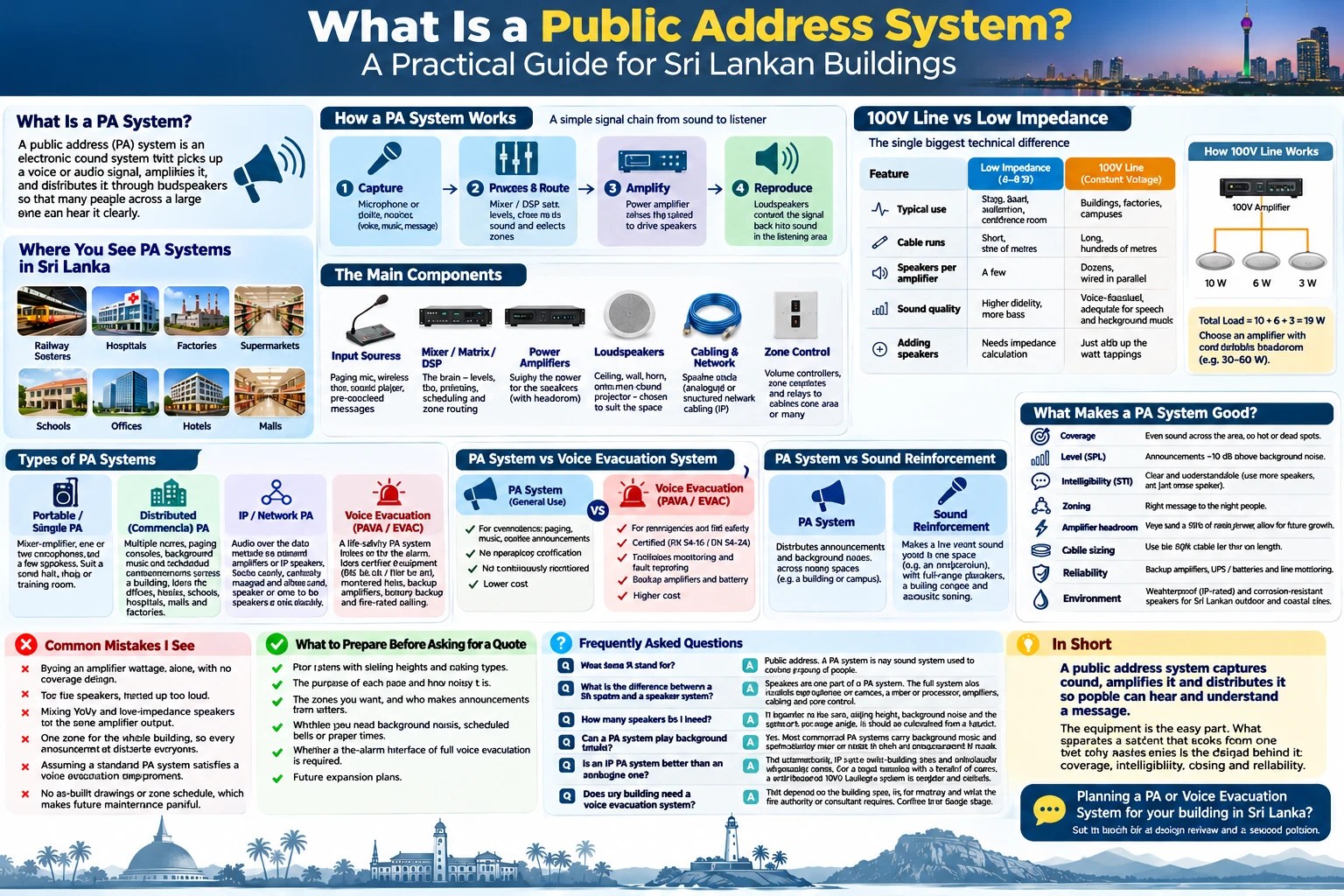
A public address (PA) system is an electronic sound system that picks up a voice or audio signal, amplifies it, and distributes it through loudspeakers so that many people across a large area can hear it clearly. Its job is simple to state and harder to deliver: the right message, to the right place, at a level and clarity people can actually understand.
You hear PA systems every day in Sri Lanka: the platform announcement at Fort railway station, the paging call in a hospital corridor, the shift bell in an apparel factory, the background music in a supermarket, the morning assembly at a school.
In this post I'll cover how a PA system works, what it is made of, the main types, and the things I look at when designing one.
How a PA system works
Every PA system, from a single-speaker setup to a campus-wide network, follows the same signal chain:
- Capture – a microphone or audio source turns sound into an electrical signal.
- Process and route – a mixer or processor sets levels, cleans up the sound, and decides which areas receive it.
- Amplify – a power amplifier raises the signal to a level that can drive loudspeakers.
- Reproduce – loudspeakers convert the signal back into sound in the listening area.
The main components
Input sources. Paging microphones (often a desk console with zone-select buttons), handheld or wireless microphones, background music players, and pre-recorded message players for chimes, bells, prayers or emergency announcements.
Mixer, matrix or DSP. This is the brain. In a small system it is a mixer-amplifier with a few inputs. In a larger one it is a digital signal processor (DSP) or audio matrix that handles priorities (an emergency call overrides music), equalisation, scheduling and zone routing.
Power amplifiers. These supply the power for the speakers. They are sized to the total speaker load, with headroom.
Loudspeakers. Chosen to suit the space: ceiling speakers for offices and corridors, wall or box speakers for classrooms and halls, horn speakers for outdoor areas and noisy factory floors, column speakers for reverberant spaces such as places of worship, and sound projectors for car parks and warehouses.
Cabling and network. Speaker cable for traditional systems, structured network cabling for IP-based ones.
Zone control. Volume controllers, zone selectors and relays that let you address one area, a group of areas, or the whole site.
100V line vs low impedance: the question that matters most
This is the single biggest technical difference between a PA system and a hi-fi or stage sound system.
Feature | Low impedance (4–8 Ω) | 100V line (constant voltage) |
|---|---|---|
Typical use | Stage, band, auditorium, conference room | Buildings, factories, campuses |
Cable runs | Short, tens of metres | Long, hundreds of metres |
Speakers per amplifier | A few | Dozens, wired in parallel |
Sound quality | Higher fidelity, more bass | Voice-focused, perfectly adequate for speech and background music |
Adding speakers | Needs impedance calculation | Just add up the watt tappings |
In a 100V line system, each speaker has a small transformer with selectable power tappings (for example 3W, 6W, 10W). You connect them all in parallel on one cable and simply add the tappings. If the total is 180W, you choose an amplifier with comfortable headroom above that. This is why almost every building-wide PA system uses 100V line.
Types of PA system
Portable or simple PA. A mixer-amplifier, one or two microphones and a few speakers. Suits a small hall, shop, or training room.
Distributed (commercial) PA. Multiple zones, paging consoles, background music and scheduled announcements across a building. This is the standard choice for offices, hotels, schools, hospitals, malls and factories.
IP / network PA. Audio travels over the data network to network amplifiers or IP speakers. It scales easily across multiple buildings or branches, is managed from software, and allows each speaker or zone to be addressed individually. It depends on a properly designed network, with PoE budgets and VLANs planned up front.
Voice evacuation (PAVA / EVAC). A PA system built for life safety. It links to the fire alarm and delivers clear, automatic evacuation messages. These systems use certified equipment (EN 54-16 for control equipment, EN 54-24 for loudspeakers), monitored speaker lines, backup amplifiers, battery backup and fire-rated cabling.
PA system vs voice evacuation system
They look similar, and this is where many projects go wrong. A general PA system is for convenience: paging, music, routine announcements. A voice evacuation system is for emergencies and must keep working when things fail, which is why it monitors itself continuously and reports faults.
If your consultant's specification or the fire authority asks for voice evacuation, a standard PA amplifier with a "fire alarm input" does not meet it. Clarify this before you compare quotes, because the two are priced very differently.
PA system vs sound reinforcement
A PA system distributes announcements and background music across many spaces. A sound reinforcement system makes a live event sound good in one space, such as an auditorium, with full-range speakers, a mixing console and proper acoustic tuning. A large venue often needs both.
What makes a PA system good
Loud is easy. Clear is the real target.
- Coverage. Even sound level across the listening area, without hot spots under speakers and dead spots between them. Ceiling speaker spacing depends on ceiling height and the speaker's coverage angle.
- Level above background noise. Announcements need to sit clearly above the ambient noise, typically around 10 dB. A quiet office and a weaving floor need completely different speakers.
- Intelligibility. Measured as the Speech Transmission Index (STI). Hard, reflective spaces such as atriums, prayer halls and factory sheds blur speech. More power makes this worse; more speakers placed closer to listeners, at lower level, makes it better.
- Zoning. Think about who needs to hear what. Guests in a hotel lobby should not hear the kitchen page.
- Amplifier headroom. Keep the speaker load to around 80% of the amplifier's rated power or less, and allow for future additions.
- Cable sizing. Long runs with thin cable waste power and reduce level at the far end.
- Reliability. Backup amplifiers, UPS or battery support, and line monitoring where announcements are critical.
- Environment. Outdoor and coastal sites in Sri Lanka need weatherproof (IP-rated) speakers and corrosion-resistant fixings. Humidity and salt air are hard on cheap horn speakers.
Common mistakes I see
- Buying on amplifier wattage alone, with no coverage design.
- Too few speakers, turned up too loud.
- Mixing 100V and low-impedance speakers on the same amplifier output.
- One zone for the whole building, so every announcement disturbs everyone.
- Assuming a standard PA system satisfies a voice evacuation requirement.
- No as-built drawings or zone schedule, which makes future maintenance painful.
What to prepare before asking for a quote
A good design starts with good information. Have these ready:
- Floor plans with ceiling heights and ceiling types
- The purpose of each area and how noisy it is
- The zones you want, and who makes announcements from where
- Whether you need background music, scheduled bells or prayer times
- Whether a fire-alarm interface or full voice evacuation is required
- Future expansion plans
Frequently asked questions
What does PA stand for? Public address. A PA system is any sound system used to address a group of people.
What is the difference between a PA system and a speaker system? Speakers are one part of a PA system. The full system also includes microphones or sources, a mixer or processor, amplifiers, cabling and zone control.
How many speakers do I need? It depends on the area, ceiling height, background noise and the speaker's coverage angle. It should be calculated from a layout, not estimated from floor area alone.
Can a PA system play background music? Yes. Most commercial PA systems carry background music and automatically lower or mute it when an announcement is made.
Is an IP PA system better than an analogue one? Not automatically. IP suits multi-building sites and individually addressable zones. For a single building with a handful of zones, a well-designed 100V analogue system is simpler and very reliable.
Does my building need a voice evacuation system? That depends on the building type, its fire strategy and what the fire authority or consultant requires. Confirm it at design stage.
In short
A public address system captures sound, amplifies it and distributes it so people can hear and understand a message. The equipment is the easy part. What separates a system that works from one that only makes noise is the design behind it: coverage, intelligibility, zoning and reliability.
If you are planning a PA or voice evacuation system for a building in Sri Lanka and want a second opinion on the design, get in touch.